FORGE FIELD GUIDE
The Nose Knows:
Understanding
Cannabis Terpenes
Understanding
Cannabis Terpenes

When people talk about cannabis, THC usually gets most of the attention. But THC is only part of the picture. Cannabis terpenes play a major role in what makes one cultivar feel (and more immediately, smell and taste) different from the next.
Open a jar of great flower and you’ll know what we mean. Bright citrus. Sweet fruit. Fresh pine. Earthy herbs. Pepper. Gas. Or something that’s difficult to describe but impossible to ignore.
Those aromas aren’t there by accident. They’re largely created by a group of aromatic compounds called terpenes.
Cannabis terpenes help give each cultivar its distinctive character, influencing its aroma and flavor while contributing to the overall experience. Because great cannabis isn’t just about how hard it hits.
It’s about the whole experience.
What Are Cannabis Terpenes?
What Are Cannabis Terpenes?
Terpenes aren’t exclusive to cannabis. They’re naturally occurring aromatic compounds found throughout the plant world, and they’re behind a lot of the smells and flavors you already know.
That citrus punch when you peel a lemon? Terpenes.
The sharp, fresh smell of pine? Terpenes.
The unmistakable floral character of lavender? Also terpenes.
Cannabis just happens to have its own impressive range.
Cannabis produces dozens of different terpenes in its trichomes, and every cultivar can produce its own combination and concentration. That combination creates what we call a terpene profile, one of the biggest reasons different cultivars can have completely different personalities.
And that’s where THC percentages stop telling the whole story.
Two strains can test at nearly the same THC percentage and still smell completely different. Taste completely different. And deliver noticeably different experiences.
Because cannabis isn’t one-dimensional.
And neither is good flower.
Terpenes Are More Than Just Smell
Terpenes Are More Than Just Smell
Before you ever take a hit, the flower is already telling you something.
Open the jar. Take it in.
Bright lemon and fresh herbs tell a very different story than dark fruit, gas, and something a little funky. Those differences aren’t cosmetic. They’re part of what gives each cultivar its own character.
Once you smoke it, those same aromatic compounds continue to show up in the flavor. What you smell going in can help shape what you taste on the other side.
The Entourage Effect
The Entourage Effect
Cannabis contains hundreds of naturally occurring compounds, including cannabinoids such as THC and CBD and aromatic compounds such as terpenes.
Researchers have proposed that these compounds can interact with one another, a concept commonly referred to as the entourage effect.
The basic idea is that cannabis may behave differently as a combination of compounds than it would if you looked at one compound in isolation.
In practical terms, that means a flower’s experience isn’t necessarily determined by its THC percentage alone. The cannabinoid profile, terpene profile, dosage, consumption method, and individual consumer can all contribute to what someone experiences.
The science surrounding the entourage effect is still developing, so it’s better viewed as an area of ongoing research than a simple formula for predicting exactly how a strain will feel.
But it reinforces an important point:
Cannabis is more complicated, and more interesting, than a single number on a label.
Why Cultivation and Curing Matter
Why Cultivation and Curing Matter
Growing excellent genetics is only part of the equation.
Terpenes are volatile compounds, meaning cultivation, harvesting, drying, curing and storage can all influence the final aromatic profile of the flower.
That’s why handling the plant correctly from harvest through packaging matters.
At Forge Canna, we approach cultivation with the idea that quality isn’t created at one particular stage. It’s built through hundreds of decisions, from the environment the plant grows in to how the finished flower is dried, cured, and stored.
The goal is simple: preserve as much of what makes the cultivar special as possible.
Don’t Choose Cannabis by THC Alone
Don’t Choose Cannabis by THC Alone
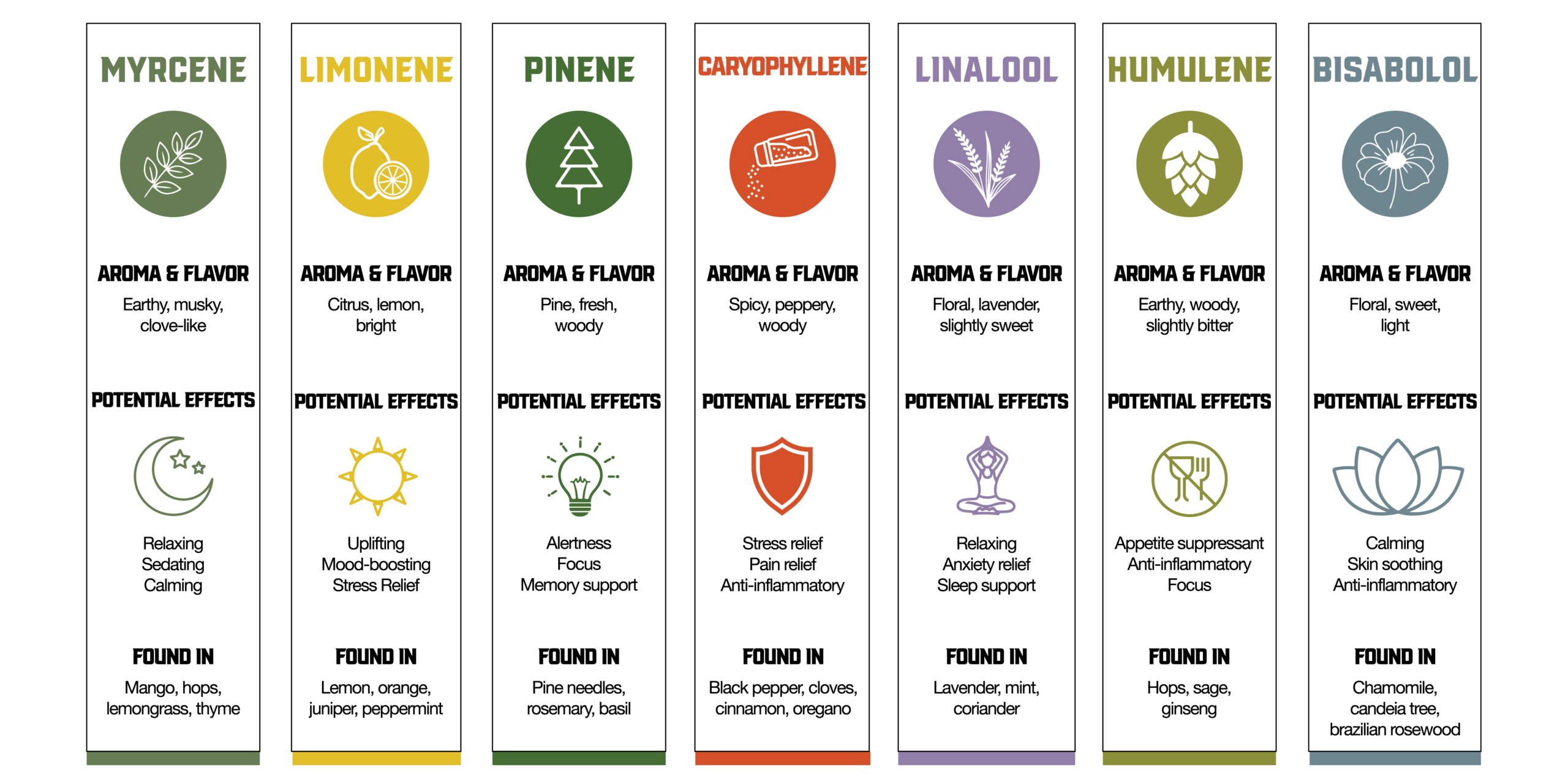
THC percentage can be useful information, but it shouldn’t be the only thing you look at. The next time you’re shopping for flower, take a closer look at the terpene profile.
Do you want something citrus-forward?
Look for limonene.
Something earthy and musky?
Myrcene might be prominent.
Looking for spicy, peppery character?
Check for beta-caryophyllene.
Prefer fresh, piney and herbal?
Pinene may be part of the profile.
And if you’re trying different cultivars, pay attention to how the aroma, flavor and overall experience change along with the terpene profile.
You may start to notice that you have preferences you never knew you had.
The Takeaway
The Takeaway
Terpenes are a huge part of what makes cannabis such a diverse plant.
They create the aromas and flavors that distinguish one cultivar from another, and they may also contribute to how we experience cannabis alongside cannabinoids and other plant compounds.
So the next time you pick up a jar of flower, don’t just ask:
“How much THC is in it?”
Ask:
“What does it smell like? What’s the terpene profile? And what kind of experience am I looking for?”
Because great cannabis isn’t just about the number on the label.
It’s about the whole profile.